Electromotive force
Energy per charge driving electric current, not a physical force.

Electromotive force (emf, or EMF) is an energy transfer to an electric circuit per unit of electric charge, measured in volts. Devices such as batteries and generators provide emf by converting other forms of energy into electrical energy, though emf itself is not a physical force.
- symbol
- ℰ (script E)
- alternative_names
- source voltage, source tension (denoted Uₛ)
- SI_unit
- volt (V)
- also_measured_in
- statvolt (cgs system)
- key_principle
- energy per unit charge (dW/dq)
- related_law
- Faraday's law of induction
Lore & Background
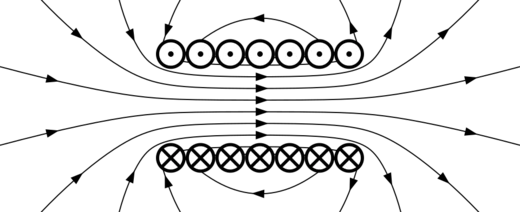
In an electrical generator, a time-varying magnetic field creates an electric field via electromagnetic induction, producing a potential difference between terminals.
Reader's Guide
Electromotive force is a fundamental concept in electromagnetism and electronics, representing the energy provided per unit charge by a source such as a battery or generator. Although it gives rise to voltage and can be measured as such, emf is distinct from potential difference. The ISO/IEC standards have deprecated the term 'electromotive force' in favor of 'source voltage' or 'source tension' to avoid confusion with physical force. Devices that provide emf include electrochemical cells, thermoelectric devices, solar cells, photodiodes, electrical generators, inductors, transformers, and Van de Graaff generators. In nature, emf is generated by magnetic field fluctuations, such as during geomagnetic storms inducing currents in electrical grids. The concept is essential for understanding how energy conversion occurs in circuits, with the emf defined as work done per charge (dW/dq).
Did You Know?
- Michael Faraday established that chemical reactions at electrode–electrolyte interfaces provide the seat of emf.
- ISO/IEC standards have deprecated 'electromotive force' in favor of 'source voltage' or 'source tension'.
- In nature, emf is generated when magnetic field fluctuations occur through a surface, such as during geomagnetic storms.
More in Electromagnetism 1-21
Spotted an error? Know more?
This is a living reference — every entry is fact-audited, and reader corrections feed straight into our audit queue. Suggest an edit · See this site's audit record