Dipole
Electromagnetic phenomenon with electric and magnetic forms.

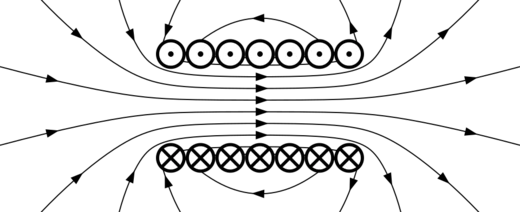
A dipole is an electromagnetic phenomenon that occurs in two forms: an electric dipole, formed by the separation of positive and negative electric charges, and a magnetic dipole, representing a sufficiently small magnet such as those due to atoms, molecules, and electrons. The strength of a dipole is characterized by its dipole moment, a vector quantity, and dipoles produce fields and experience forces and torques proportional to that moment.
- field
- Physics
- known_for
- Electric and magnetic dipole phenomena, dipole moment, multipole expansion
Lore & Background
The term dipole originates from Ancient Greek δίς (dís) 'twice' and πόλος (pólos) 'axis'. An electric dipole is typically represented by a pair of equal but opposite electric charges separated by a small distance, with the dipole moment pointing from the negative charge to the positive charge. A magnetic dipole is typically modeled as a loop of constant current, with the magnetic dipole moment pointing through the loop according to the right hand grip rule.
Reader's Guide
Dipoles are fundamental in physics because they describe the behavior of atoms, molecules, and electrons at large distances. The dipole moment is the dominant term in the multipole expansion for charge distributions with no net charge, producing fields that fall off as 1/r³. Electric dipoles produce electric fields and experience forces and torques in electric fields, while magnetic dipoles behave analogously in magnetic fields. The equations for magnetic dipoles are nearly identical to their electric counterparts. Although magnetic monopoles do not exist in nature, magnetic dipoles exist due to quantum-mechanical spin and electron currents around nuclei. The concept of an ideal dipole, obtained by letting separation tend to zero while keeping dipole moment fixed, simplifies field calculations and is crucial for understanding electromagnetic interactions at a distance.
Did You Know?
- The electric dipole moment points from the negative charge towards the positive charge.
- Magnetic dipoles are typically modeled as a loop of constant current, with moment equal to current times area.
- The field of a dipole falls off in proportion to 1/r³, compared to 1/r⁴ for the quadrupole term.
- In chemistry, the opposite sign convention for the electric dipole (from positive to negative) is used.
Frequently Asked Questions
What is Dipole in the context of Electromagnetism 1-21?
A dipole is a fundamental electromagnetic configuration that appears in two distinct forms: an electric dipole produced when positive and negative charges are spatially separated, and a magnetic dipole that captures the field pattern of a sufficiently small magnet, such as the one associated with individual electrons, atoms, or molecules.
What is Dipole's signature ability or defining property?
The dipole moment is the vector quantity that quantifies the strength and orientation of a dipole, and it directly determines both the field the dipole generates in its surroundings and the forces and torques it experiences when immersed in an external electromagnetic field.
How does Dipole's influence behave at long range?
In the multipole expansion used to decompose complex charge or current distributions, the dipole term is the leading correction beyond the net-charge (monopole) term, and its field decays with the inverse cube of distance rather than the inverse square, making it the dominant contribution once the net charge vanishes.
Why is Dipole considered a cornerstone concept in the field of Physics?
Dipoles show up throughout physics—from the way atoms and molecules respond to applied electric and magnetic fields to the radiation patterns of everyday antennas—so the dipole approximation remains one of the most frequently applied simplifications in all of classical and quantum electromagnetism.
What distinguishes Dipole's electric form from its magnetic form?
An electric dipole is created by physically separating positive and negative charges, whereas a magnetic dipole is produced by a small current loop or by the intrinsic spin of a particle; although their field equations look mathematically analogous, the two are sourced by fundamentally different physical mechanisms.
More in Electromagnetism 1-21
Spotted an error? Know more?
This is a living reference — every entry is fact-audited, and reader corrections feed straight into our audit queue. Suggest an edit · See this site's audit record