Electric current
Flow of charged particles through a conductor or space.

Electric current is a flow of charged particles, such as electrons or ions, through an electrical conductor or space. It is defined as the net rate at which electric charge flows through a surface. The moving particles are called charge carriers, which may be of several types, depending on the conductor. In electric circuits, the charge carriers are often electrons moving through a wire. In semiconductors, the charge carriers can be electrons or holes. In an electrolyte, the charge carriers are ions, while in plasma—an ionized gas—they are also ions and electrons.
- SI unit
- ampere (A)
- Symbol
- I
- Base quantity
- Yes, in the International System of Quantities (ISQ)
- Measurement device
- ammeter
- Common forms
- alternating current (AC) and direct current (DC)
- Key law
- Ohm's law (I = V/R)
Lore & Background
The conventional symbol for current is I, originating from the French phrase intensité du courant (current intensity). The I symbol was used by André-Marie Ampère, after whom the unit of electric current is named, in formulating Ampère's force law (1820). The conventional direction of current, also known as conventional current, is arbitrarily defined as the direction in which positive charges flow. In metals, negatively charged electrons are the charge carriers, free to move about in the metal. In other materials, notably semiconductors, the charge carriers can be positive or negative, depending on the dopant used. Positive and negative charge carriers may even be present at the same time, as happens in an electrolyte in an electrochemical cell. A flow of positive charges gives the same electric current, and has the same effect in a circuit, as an equal flow of negative charges in the opposite direction. Negatively charged carriers, such as the electrons, therefore flow in the opposite direction of conventional current flow in an electrical circuit.
Reader's Guide
Electric current is a fundamental concept in physics and engineering, underpinning modern electrical and electronic systems. It is measured in amperes, an SI base unit, and is quantified using an ammeter. Current creates magnetic fields, enabling motors, generators, inductors, and transformers. In ordinary conductors, it causes Joule heating, which produces light in incandescent light bulbs. Time-varying currents emit electromagnetic waves, used in telecommunications. Ohm's law relates current, voltage, and resistance, providing a core tool for circuit analysis. Alternating current (AC) periodically reverses direction and is the form most commonly delivered to businesses and residences, while direct current (DC) flows in one direction and is produced by batteries, solar cells, and dynamos. Natural examples include lightning, static electric discharge, and the solar wind. Man-made occurrences include conduction electrons in metal wires, eddy currents in conductors exposed to changing magnetic fields, and currents in radio antennas. Biological examples include the flow of ions in neurons and nerves, responsible for thought and sensory perception. Measurement techniques include shunt resistors, Hall effect sensors, transformers, magnetoresistive field sensors, Rogowski coils, and current clamps.
Did You Know?
- The symbol I for current originates from the French phrase intensité du courant.
- The ampere is an SI base unit, equivalent to one coulomb per second.
- In metals, the charge carriers are electrons, which flow opposite to the direction of conventional current.
The Nature of Current and Its Many Carriers
An electric current is fundamentally a stream of charged particles moving through a conductor or even through open space. More precisely, it is defined as the net rate at which electric charge passes through a given surface. The particles doing the moving are called charge carriers, and their identity shifts dramatically depending on the medium. In the metal wires that thread through most everyday circuits, the positively charged atomic nuclei sit locked in place while negatively charged electrons drift freely, serving as the carriers. In semiconductors, the picture grows richer: carriers may be electrons or so-called holes, and which one dominates depends on the dopant introduced into the crystal. In an electrolyte, the carriers are ions, and both positive and negative ions can be present and moving at the same time, as in an electrochemical cell. In plasma, an ionized gas, both ions and free electrons participate in the flow. This diversity means that a single physical phenomenon—current—can be carried by very different species across the full range of materials and environments.
Measurement, Units, and the Language of Current
The International System of Units assigns electric current the status of a base quantity, with its unit being the ampere, commonly shortened to "amp" and marked with the symbol A. One ampere corresponds to one coulomb of charge passing per second. Because it holds base-unit status in both the SI and the International System of Quantities, current sits at a foundational level of measurement. In practice, engineers and technicians measure it with an instrument called an ammeter, and the quantity is sometimes referred to colloquially as amperage. The standard symbol for current is the letter I, a choice that traces back to the French phrase intensité du courant, meaning current intensity. André-Marie Ampère, the physicist after whom the unit is named, employed this very notation when he formulated his force law in 1820.
Conventions, Direction, and the Logic of Circuit Analysis
Because current can be carried by positive charges, negative charges, or both simultaneously, a universal convention is needed to describe its direction without depending on which species is actually moving. The so-called conventional current is defined as the direction in which positive charges would flow. In a metal wire, where the real carriers are negatively charged electrons, this means the electrons physically travel opposite to the conventional current arrow. A flow of positive charges produces exactly the same circuit effect as an equal flow of negative charges moving the other way, which is why the convention works universally. In practical circuit analysis, the true direction of current through any given element is typically unknown before the math is done. Engineers therefore assign a reference direction—usually indicated by an arrow on a schematic—arbitrarily. If the solved value turns out negative, it simply tells the analyst that the actual flow runs opposite to the chosen reference. This bookkeeping device keeps the algebra clean regardless of the carrier type or the eventual direction of flow.
Applications, Natural Phenomena, and the AC–DC Divide
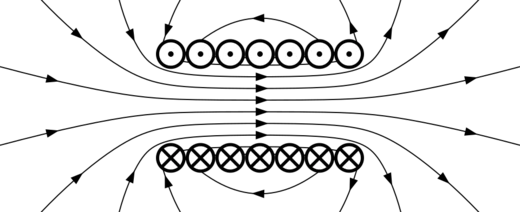
Electric current underpins a remarkable range of technologies and natural events. In ordinary conductors, the resistance to flow produces Joule heating, the principle behind the glowing filament of an incandescent bulb. Moving charges also generate magnetic fields, which are harnessed in motors, generators, inductors, and transformers. When the current varies with time, it radiates electromagnetic waves—the foundation of telecommunications and information broadcasting. On the power-delivery side, alternating current, in which charge periodically reverses direction, is the standard form supplied to homes and businesses, typically as a sine wave though triangular or square waveforms appear in specialized uses. Direct current, where charge moves in a single direction, comes from batteries, solar cells, thermocouples, and commutator machines, and can also be produced by rectifying AC. DC is not limited to wires; it can flow through semiconductors, insulators, or even a vacuum as electron or ion beams. Nature provides its own currents in lightning, static discharge, and the solar wind that paints the polar auroras. Ohm's law, expressing current as voltage divided by a constant resistance, remains the foundational relationship tying these phenomena together.
Frequently Asked Questions
Who is Electric current?
Electric current is the steady migration of charged particles—electrons, ions, or holes—across a conductor or open space. It is quantified as the net rate at which charge passes a given surface, and its SI unit is the ampere.
What are Electric current's powers and role?
It appears in two primary forms: direct current (DC), where carriers drift in one direction, and alternating current (AC), where the flow reverses periodically. In wired circuits it powers everything from lightbulbs to microchips, while in electrolytes and plasmas it ferries charge via ions and free electrons.
How does Electric current's story end?
When a circuit is opened or the driving voltage drops to zero, the drift of charge carriers ceases and the current fades to nothing. In resistive materials, the energy it carried is shed as heat before the particles simply settle back into their resting positions.
Why is Electric current important?
It is the fundamental mechanism by which electrical energy is delivered and converted into light, motion, or heat in virtually every modern device. Without it, no circuit, motor, or signal could function.
What law governs Electric current's behavior?
Ohm's law (I = V/R) ties its magnitude directly to the applied voltage and the resistance of the path it must traverse. This relationship is the backbone of nearly all circuit analysis.
More in Electromagnetism 1-21
Spotted an error? Know more?
This is a living reference — every entry is fact-audited, and reader corrections feed straight into our audit queue. Suggest an edit · See this site's audit record